
-
 October 29, 2025
“God made angels, and we call them mothers.”
The very first person we know on earth, even before seeing the colors of the day, is our mother. Happy is the flower which upon appearing above the ground is greeted by a warm sunshine. It feels welcomed, embraced, and so thrives and flourishes to its full potential. The highest point for any flower is when it makes it to God's altar in His worship. Like the sunshine to the flower, so a warm hug to a child. Such warmth and love are made possible in a family. Family becomes the seedbed of all values and virtues. Mothers play a vital role in providing such an ambience for a child to thrive in life. A mother feels highly honored when her child makes it to God’s altar in His worship.
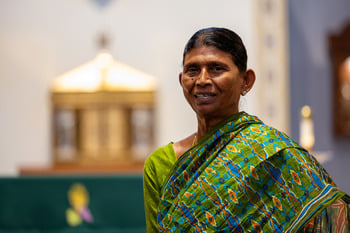
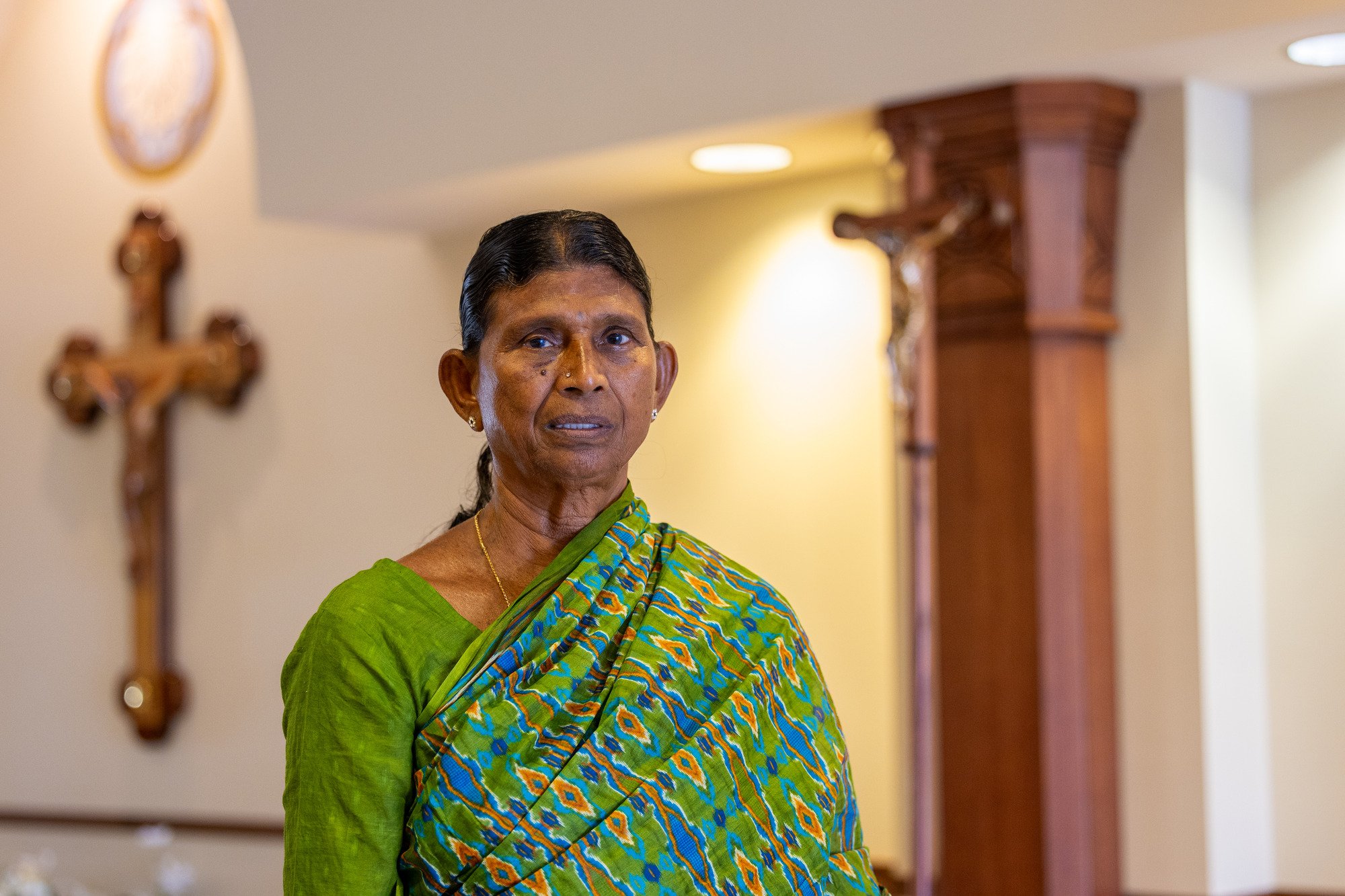
Mrs. Bharathamma (first name) Arikotla (last name) is the mother of Rev. Vidya Sagar Arikotla, also known as Father Sagar. He came to the Diocese of Grand Island in 2014, and eventually he incardinated (became a permanent member) of the diocese. After 11 years of his ministry in the United States, his mother traveled across the oceans to see her son in his priestly stomping grounds. It is hard to imagine for a person who has never gone out of her usual surroundings to take several connecting flights to travel to a town called North Platte in the middle of the United States. Father Sagar recounts how she was jittery and agitated while driving from Denver to North Platte, after landing at the airport and how she complained about the distance of the land.
Mrs. Bharathamma hails from a south Indian state called Telangana. She was born in a family of eight children, of whom seven are girls and the last one is a boy. Indian society prefers to have a boy child rather than a girl child. She says, “My parents longed to see a boy child in the family. Finally God did show mercy on them after seven girls, so they called it good.” Mrs. Bharathamma was born to poor peasants. Their religion was Hinduism not by choice but by birth. Hinduism is the most popular religion then and even now in India. “During our days, they did not send kids to school as much as they do today, and much less the girl babies,” recalls Father Sagar’s mom. As a result, “I did not get any formal education whatsoever. So, I cannot read or write my native language called Telugu or any other language.”
During our interview with Mrs. Bharathamma, we learned more about her faith journey in a place that was surrounded by hostile conditions.
Did you grow up in the Catholic faith? How did your relationship with Jesus start?
“I received my baptism, first Communion, and confirmation at the time of my wedding. Marriages in India are always arranged, especially in our days. Our parents found a man named Jacob Arikotla for a match, in a village about thirty miles from ours. He was a Catholic who wanted to marry me only if I converted to his religion. I liked him, I had no option. We used to have Mill Hill missionaries at that time from Europe, mostly from Italy. They were very good with us.”
How did your family and relatives feel about you choosing to be a member of the Catholic faith?
“Yes. I still have many family members who are staunch Hindus. They did not appreciate my choices. Even though I became a Catholic, for a long time I was forced to practice superstitious Hindu beliefs whenever I found myself in their midst.”
Christians are discriminated upon in India. To avoid hate toward my kids, we gave them very Hindu names, thus our kids names by birth order are Bhaskar Rao (which means, “sun god” in Sanskrit), Ravi Kumar (Which also means “sun god” in Sanskrit) and Vidya Sagar (which means “ocean of knowledge” in Sanskrit).”
“But eventually I cut loose from those influences. I know that Jesus is the only true God and Savior the world is waiting for. I am glad to see my relatives are beginning to understand my witness of faith and slowly converting to Christianity.”
Are they happy that your son is a priest?
“Absolutely. There is no doubt. They look up to him and give him the respect that he deserves as God’s servant.”
Are you happy with your son’s decision to become a priest?
As her eyes beamed up, she responded, “Of course, yes, since the time he was a kid, he expressed the desire to be a priest. We used to call him a little priest already when he was growing up. When he was very young, like eight years, a priest lifted him up to a thunderous applause of a congregation during an ordination Mass and said that my son would become a priest someday. Since then, he was known as a little priest.”
“Even though I lost one of my three boys to some mysterious illness when he was just twenty-three years old and lost my husband a year later, I did not lose heart. I still encouraged my son to pursue what he desired as a little kid. Many of my Hindu siblings and other close relatives advised me to abandon Jesus and call my son away from seminary in anger after the loss of my loved ones. They quoted the Bible saying those who believe in Jesus will always come across bigger crosses and Jesus would test his followers to a breaking point. They tried to persuade me that the Hindus are happy, because their gods take care of them if they appease them with small animal sacrifices. Initially I was convinced of these arguments, but later none of them made any sense to me.
In what ways do you serve your church at home?
“Our town does not have a main parish church,” she continues, “We are a mission parish. Our pastor comes to our town once a week to pray the Mass. We all take part in our faith quite actively. A small group of us recite the holy rosary daily in our church, take turns to clean the church and surroundings. We are a poor church, but we make things work. Recently my son sent some help to build a compound wall around the church and do some upkeeping things. All the people also actively donated their time and work hours towards this. We are glad that project was accomplished well.”
What brought you to America?
“Of course, my son. I wanted to come and see him much before, but finally I am glad things worked out. I used to worry about my son a lot before I came here, because you know he is too far from us. Whenever I see our parish priest in our home parish, I wish my son was near to us. But everything has its destiny. We will work with what God has set before us. But now that I have seen him here, I am not going to worry as much. He is happy and doing what he is supposed to do.”
How do you feel about the people in America?
“I love them. They are amazing people. Even though I do not know the language, I can feel their inner beauty. I received more hugs here in my three months than I ever did in life. They are warm bodies who opened their warm hearts to my son and now to me.”
She continues, “The very first impression I received here was their faith. It is beyond my imagination that the church is full every Saturday and Sunday. I used to think there is no faith in America. I guess I am wrong.”
She went on by saying, “Regarding the vast open lands and fields, I cannot describe it enough. I cannot fathom God’s creation; it is so beautiful. Those rolling hills, vast corn and soy fields take my breath away. By the way, the beef is tasty here.”
What kind of food do you like in America? Did you try any food at all?
While smiling ear to ear she narrates, “The food is very different here. We are not used to this bland food. We are used to eating spicy foods. I brought a lot of spices for my son when I came from India. I am also glad to see the type of spices being available in stores in America. You asked me about the food I liked; I would say Salmon, rice, and broccoli.”
What will you tell those at home about the people in America?
“They are good people. I hope to see them again in the future. I will miss them. My faith has grown to a different level after praying with them daily. I will share my faith journey to people back in India.”
What message do you have for us as you return to India?
“My son has come a long way to be with you. He is following the missionary spirit of the priests who gave him this vocation. I am going to leave the country soon with a heavy heart in an assurance that all is going to be well. It is always hard to say goodbye.”
To close the conversation, The West Nebraska Catholic posed one final question to Father Sagar, who serves the parishes of Holy Spirit in North Platte, Our Lady of Guadalupe in Hershey, and Sacred Heart in Sutherland.
How would you describe your mother?
She is one heck of a trooper. She endured a lot, like poverty, the loss of my brother, the loss of my dad in her late 40s. She is a real mama bear in every sense of the word. When I was studying third grade in a boarding home, I was spanked by a warden (boarding in charge). I wrote a small postcard to my dad and let him know that this happened. One evening when all the kids (about 150 of us) were sitting on the floor in rows and doing our homework, I felt the assuring touch of someone on my shoulders. It was my mother who came to see me, walking about ten miles from our home. The very first thing she asked me was, “who is the one that spanked you?” I pointed to the one that did it. She walked straight to him in front of all the kids, pulled him by the shirt, and spanked him several times and warned him not to touch me anymore. After a small visit with me, she went back home walking the same distance. That is the kind of a person she is even to this day.